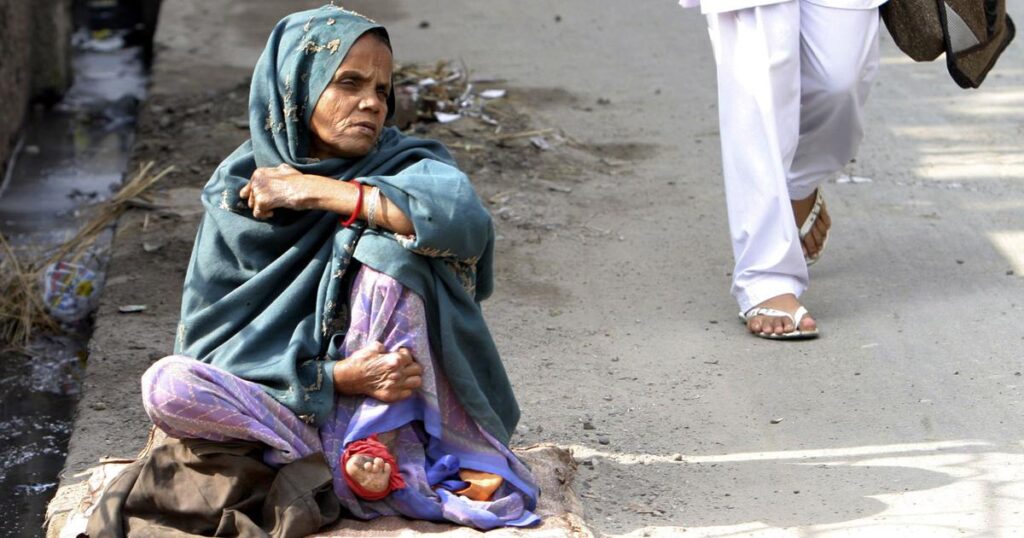
We have seen that only a small fraction of homeless people beg for alms for a living, and these tend to be persons who are disabled or ageing. But the laws and police actions that criminalise begging, vending at traffic lights, street performances and even just ostensible destitution, make survival even more hellish for them, and dignified survival an impossibility.
There are many ways that the law in India empowers State authorities to lock up, and indeed lock away our most vulnerable people. These include in every city significant numbers of homeless people.
Before you read further…
Get the best & trending news directly in your email for free.
Most jails are packed with impoverished and socially disadvantaged people, held for prolonged periods without conviction, frequently for petty offences. Children without adult care and protection are housed sometimes for their entire childhood in jail-like State-run juvenile homes. Girls and women deemed by the State or judicial authorities to be “in moral danger”, including those rescued from sex work or young women in inter-religious or inter-caste relationships, are incarcerated in custodial women’s homes, often confined all day in small spaces with no opportunities for play and privacy.
Laws to criminalise beggary were enacted in India for the first time under colonial rule, overturning a very different civilisational tradition which taught the giver to treat the person in need with respect even while giving. Some of India’s greatest sons like Gautam Buddha, begged to learn humility, a tradition carried on by Sufi and Bhakti saints in medieval times. The moral idea that begging is an abomination that should be a punishable crime is part of a much later colonial legacy.
The first law on beggary and vagrancy in India was the European Vagrancy Act of 1874. This dealt with “vagrants” of European descent. The Criminal Procedural Code of 1898 also empowered the State to act against “vagrants”, “beggars” and other “status offenders”; and to arrest and detain all manner of “undesirable persons” and “vagabonds”. Additionally, “vagrants” and “beggars” were subjected to penal provisions under various local laws and codes, such as Police Acts, Municipal Acts, as well as in federal laws like the Indian Railways Act, 1941, which criminalised begging in the railways. (Note the continuously unproblematic use in law of socially pejorative, even humiliating, labels for vulnerable, dispossessed people who might be homeless, unemployed, mentally ill, living with stigmatised ailments like leprosy, and destitute).
Laws specifically criminalising begging were enacted in the 1940s in the wake of large-scale destabilisation caused by post-war unemployment and economic recession. Although these laws originated before independence, they have continued in the many decades of freedom which followed, denying the most destitute both freedom and dignity. 20 states and two union territories passed laws to criminalise beggary. What these laws accomplish is to criminalise begging and, in the final analysis, destitution. They also prescribe custody, trial and punishment of beggar offenders, and their detention in custodial beggars’ “homes”, bleak and unsanitary institutions that combine the worst features of the poor-houses of Victorian England with India’s oppressive prison system.
“Begging” under all these laws is defined expansively to bring within their ambit not only beggars, meaning those caught in the act of soliciting alms, but also others who, due to their visibly destitute condition, are presumed to be beggars. Typically, a beggar is defined in most of these laws to include anyone without “ostensible means of livelihood”, which really means that these laws make destitution not a subject of social assistance but of crime. Since many beggars suffer from leprosy and mental illness, the law implicitly criminalises these ailments as well. It even includes traditional artists, as “singing, dancing, fortune-telling, performing or offering any article for sale” are deemed as offences under this statute.
The penal consequences of begging in public places vary from release after admonition or personal bonds for first-time offenders to detention for up to 10 years. The offence of beggary is established on the basis of summary trials in designated “beggars’ courts” that are presided over by a first-class magistrate or a special magistrate. These courts are known to follow whimsical practices, making assumptions about a person resorting to begging without even the conventional requirements of evidence. All the laws provide strict penalties and imprisonment for those employing or causing persons to beg or using persons for begging.
Any police officer is authorised to arrest without a warrant any person who is found begging under this wide definition. It is this draconian power that is used routinely by the police to reduce all homeless people to a continuous state of fear and insecurity for the mere fact that they lack “visible means of subsistence”, for which “crime” they can be beaten, abused, chased, rounded up or arrested.
All who interact closely with homeless people in any part of the country would testify that the police tend to use these powers against these softest of targets routinely with excess brutality. I recall the utterly distraught faces of elderly women begging at Hanuman Mandir, New Delhi, because the tiny, begrimed bundles containing all their worldly belongings had been, for no reason, set on fire by a raiding police team.
It is significant also that although all these laws contain provisions on the procedure to be adopted for detaining beggars in certified institutions, there are few with provisions that specifically outline measures to be taken for their welfare, empowerment, or rehabilitation. Most of these laws allow for the detention of dependents of beggars as well as indefinite detention of “incurable beggars”. All of this poses serious challenges to the rights to life and liberty enshrined under the Constitution.
Practice reveals that the implementation of these laws has nowhere met with the stated objectives of preventing beggary and have instead led to the further marginalisation, harassment, and violation of the fundamental rights of those who are already marginalised and destitute. This is because the law and its practice pay no heed to reasons that lead to destitution nor facilitate responses that address destitution or uphold the rights of marginalised citizens.
Both the letter and spirit of these laws remain extremely oppressive to many of the most dispossessed and vulnerable of our people. On the basis of summary and usually completely arbitrary and whimsical trials, often by magistrates disgruntled by their posting to a beggars’ court, a person found to be a beggar may be detained for a period not less than one year, but which may extend even to three years. Beggars’ homes are abysmally worse in public services than even jails, because of the powerlessness and stigma of their hapless residents, with watery food and confinement often for 24 hours in dormitories that reek of the smell of excreta and cramped unwashed human bodies. There are no recreational or rehabilitative services, and many die lonely deaths within the confines of these institutions. Many have no families to visit them, others are too poor, and yet others are ashamed to let their families know that they are incarcerated for beggary. 60-year-old Abdul came to Delhi from his home in Assam on a heartbreaking search for his runaway mentally ill son, was rounded up and sentenced for three years on the charge of beggary. But he has not informed his family about his incarceration. “If it was jail, I would tell them, however they now may actually believe that I was begging. This humiliation I would not be able to bear.”
In Chennai, we found in 2007 that the government spent Rs 3,600,000 annually to confine 116 alleged beggars in sub-human conditions of misery, of which 86% was expended on staff salaries. It spent Rs 27,000 per inmate annually, or nearly Rs 100,000 for three years of their confinement. It did not find it fit, however, to spend a fraction of this on the rehabilitation and social security of these most wretched of our earth.
The laws enacted institutionalise discriminatory social attitudes towards impoverished and marginalised peoples and migrants. These beliefs provide a moral framework for enacting beggary laws to criminalise the destitute poor. The destitute poor are perceived to be inferior or sub-human. The ways of life of the destitute poor are considered antithetical and an affront to the ‘civilised’ way of life. And the poor need to be disciplined and educated in order to be converted into a resource for the larger economy. If spared this disciplining, it is believed that the poor would be idlers and social parasites.
Unfortunately, laws aimed at preventing begging do exactly the reverse – they criminalise poverty by criminalising destitution and locking away people living in extreme poverty without enforcing the corresponding State obligation to ensure access to livelihood and a life of dignity. Despite constitutional mandates, the Indian State has failed to put in place any system providing old-age benefits or social security to address the needs of its destitute population. Instead, as observed by the Delhi High Court, “No doubt poverty is a curse and a poor man has to suffer in society at different fronts, but I cannot consider that despite poverty being a curse, poverty cannot be made a crime.”
Excerpted with permission from Under Grey Smoggy Skies: Living Homeless on the Streets of India’s Cities, Harsh Mander, Yoda Press.